Morpheus8 vs. SkinPen Microneedling in Miami: Why We Chose SkinPen
Considering RF microneedling like Morpheus8? Before you book, read what the FDA said in October 2025 — and why SkinUp uses SkinPen, the first microneedling device to receive FDA De Novo clearance with dedicated clinical trial data.
When a patient asks about Morpheus8, the conversation usually starts the same way: they’ve seen it on social media, a friend mentioned it, or they Googled “RF microneedling Miami” and found a list of practices offering it. The technology sounds impressive — radiofrequency energy delivered through microneedles, skin tightening and collagen stimulation in one session.
It’s a reasonable thing to be curious about. But there’s a question worth asking first: what does the FDA actually say about RF microneedling?
At SkinUp Aesthetics & Wellness in Kendall, we use SkinPen® Precision for microneedling — and that choice is grounded in a specific reason. This post explains the difference between RF microneedling and SkinPen, what the FDA’s October 2025 Safety Communication means for patients considering these treatments, and why we believe SkinPen is the more appropriate choice for our patients.
The FDA Safety Communication: What Changed in October 2025
On October 15, 2025, the U.S. Food and Drug Administration issued a Safety Communication titled “Potential Risks with Certain Uses of Radiofrequency (RF) Microneedling.” The FDA notified patients and healthcare providers that serious complications had been reported with RF microneedling devices — complications that go well beyond typical post-treatment redness and swelling.
The reported adverse events included:
- Burns and scarring requiring medical or surgical intervention
- Facial fat loss (lipoatrophy) — particularly in the cheeks, temples, and under-eye area
- Disfigurement resulting from unintended tissue damage
- Nerve damage, including numbness and dysesthesia
The FDA noted that its review is ongoing and that the true frequency of these problems is currently unknown, in part because reporting is voluntary. The agency recommended that patients seek care from licensed healthcare providers with specific training on device settings and facial anatomy — and emphasized that the risks are real and serious.
This wasn’t a minor regulatory footnote. It was a formal alert from the country’s primary medical device regulator.
Why RF Microneedling Carries These Risks
To understand the risk, you need to understand the mechanism. RF microneedling devices — including Morpheus8 — work by inserting needles into the skin and then delivering radiofrequency electrical energy through those needles. The goal is to create heat in the deeper layers of the skin, stimulating collagen remodeling and tissue tightening.
The problem is thermal dose and depth control. When RF energy is delivered at deeper settings, it can reach the subcutaneous fat layer — the layer of fat that sits just beneath the dermis. When fat tissue absorbs that heat, it can be damaged or destroyed, leading to volume loss that isn’t intended, isn’t reversible in a straightforward way, and is directly at odds with the goals of modern aesthetic medicine.
Facial fat preservation is foundational to how we think about aging and aesthetic outcomes. We spend significant effort restoring volume with fillers like Sculptra and Radiesse in patients who’ve lost fat in the cheeks, temples, and under-eyes over time. The idea that a skin treatment could simultaneously and unintentionally remove that volume — particularly in areas that are already prone to natural volume loss — is a meaningful clinical concern.
Beyond fat loss, RF energy delivery is highly operator-dependent. The outcome depends on needle depth, energy settings, pass count, and the provider’s anatomical knowledge. In expert hands with optimal settings, complication rates are lower. But the FDA’s communication makes clear that serious complications are occurring — and that the mechanism makes them possible even in experienced settings.
What SkinPen Is — and Why It’s Different
SkinPen® Precision is a microneedling device manufactured by Crown Aesthetics. It holds the distinction of being the first microneedling system to receive FDA De Novo clearance as a Class II medical device — a clearance designation granted in March 2018 under DEN160029. De Novo is a more rigorous pathway than the 510(k) substantial-equivalence route; subsequent microneedling devices cleared via 510(k) have used SkinPen’s De Novo classification as their predicate.
De Novo clearance is meaningful. It means SkinPen went through a dedicated FDA review process with its own clinical trial data, rather than relying on substantial equivalence to a predicate device (the pathway used by most 510(k) clearances). The FDA reviewed the SkinPen clinical study and determined that the device was safe and effective for its intended use.
That clinical study produced an important result: 90% of patients reported improvement in the appearance of their facial acne scars at six months after three treatments. The six-month timeframe reflects something important about how microneedling works — collagen remodeling continues for months after the final session, meaning results continue to improve long after the treatment course is complete.
What makes SkinPen different from RF devices comes down to what it does not do:
No radiofrequency energy. SkinPen creates controlled micro-injuries through mechanical action only — precision needles creating micro-channels in the skin, triggering the body’s natural wound-healing response (collagen and elastin production) without heat.
No thermal risk. Without RF energy, there is no risk of thermal injury to the dermis or subcutaneous fat. Burns, heat-induced scarring, and fat loss are not mechanisms that apply to SkinPen’s treatment modality.
Safe for all skin types, including melanin-rich skin. This matters enormously in Miami. Our patient population is diverse — Cuban, Colombian, Venezuelan, Caribbean, and mixed-heritage patients make up a significant part of the community. RF devices can cause post-inflammatory hyperpigmentation in melanin-rich skin, while SkinPen’s mechanical mechanism has a well-established safety profile across all Fitzpatrick skin types.
Single-use, sterile cartridges. Each treatment uses a disposable cartridge, eliminating any cross-contamination risk.
Minimal downtime. Redness resolves within 24–48 hours for most patients. There is no extended recovery, no prolonged inflammation from heat exposure, and no post-treatment skin texture disruption beyond what normal healing involves.
SkinPen vs. Morpheus8: A Direct Comparison
| SkinPen® Precision | Morpheus8 (RF Microneedling) | |
|---|---|---|
| FDA Pathway | De Novo clearance (Class II, DEN160029) | 510(k) predicate-based |
| Clinical Trial Data | Yes — dedicated FDA clinical study | Limited independent data |
| Energy Delivered | Mechanical only | Radiofrequency + mechanical |
| Fat Loss Risk | None | Yes — documented, cited in FDA alert |
| Burn/Scar Risk | Minimal | Yes — cited in FDA Safety Communication |
| Safe for All Skin Types | Yes | Requires careful setting adjustment for darker tones |
| Downtime | 24–48 hours redness | 3–7+ days; variable by settings |
| FDA Safety Alert | None | October 2025 Safety Communication |
This comparison is not designed to suggest that RF microneedling has no legitimate uses or that every provider offers it irresponsibly. The point is that for our patient population and our clinical standards, SkinPen represents a more evidence-anchored, lower-risk choice — and the FDA’s October 2025 communication reinforced what thoughtful clinicians had already been discussing.
What Microneedling at SkinUp Actually Looks Like
Our microneedling treatments follow a consistent, personalized approach.
Consultation. Before any treatment, you’ll have a thorough skin evaluation. We discuss your concerns — whether that’s acne scarring, texture, pore size, fine lines, or overall skin quality — and determine whether microneedling is the right approach, what pairing makes sense (PRP, hyaluronic acid, or growth factors), and what a realistic treatment series looks like for your skin.
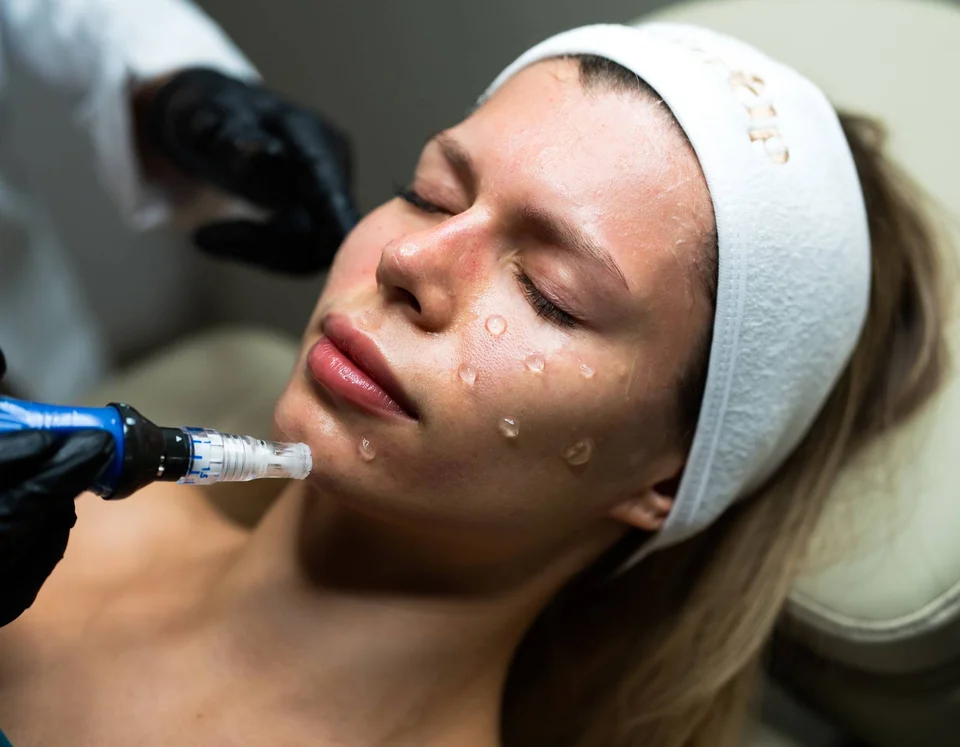
Preparation. A topical numbing cream is applied 20–30 minutes before treatment, ensuring your comfort throughout. The session itself takes 60–90 minutes including prep.
Treatment. The SkinPen device is passed over the treatment area in a systematic pattern. The sensation is typically described as mild vibration or light scratching — not painful, though individual comfort varies. A customized topical serum (hyaluronic acid, growth factors, or PRP) is often applied during and after treatment — a common clinical adjunct practice to support hydration and healing, separate from the device’s FDA-cleared indication.
Recovery. Expect pink-to-red skin for 24–48 hours. Most patients return to their normal schedule the same day or the following morning. Final results develop progressively over 4–6 weeks as the collagen remodeling cycle unfolds, with continued improvement reaching its peak at around six months.
Treatment series. Most patients do best with a series of 3–6 sessions spaced 4–6 weeks apart. Acne scarring and deeper texture concerns typically require more sessions; general skin quality and fine lines often respond with fewer.
Who Is a Good Candidate?
Microneedling with SkinPen at SkinUp tends to work well for patients dealing with:
- Acne scars — rolling, boxcar, and shallow ice-pick types
- Uneven skin texture and enlarged pores
- Fine lines and early skin laxity
- Dull, fatigued-looking skin that lacks radiance
- Overall skin quality concerns in patients who want a collagen-stimulating treatment without the risks of heat-based devices
- Patients with melanin-rich skin who want a safe, proven option for skin renewal
It is not an ideal standalone treatment for deep structural wrinkles, significant skin laxity, or concerns where volume restoration (with fillers) would address the root issue more directly. At your consultation, we’ll give you an honest assessment of whether microneedling is the right approach for your goals — and whether combining it with other treatments would produce better results.
The Reason We Made This Choice
SkinUp could offer RF microneedling. The devices are available, and Morpheus8 in particular has been heavily marketed as a premium skin-tightening option. We chose not to, and we’ve been clear with our patients about why.
Aesthetic care advances quickly, and not every advancement represents progress. The FDA’s October 2025 alert on RF microneedling wasn’t surprising to providers paying close attention to the clinical literature — reports of adverse fat loss, burns, and unintended tissue damage had been accumulating in the literature and in community forums for years before the formal safety communication.
SkinPen has a 30-year legacy of microneedling science behind its design, dedicated clinical trial data, and a safety profile that’s well understood across diverse skin types. For a practice built around natural results, whole-patient care, and long-term thinking, the choice was clear.
Financing. SkinUp accepts Cherry, a flexible financing partner that allows patients to split treatment costs across monthly installments. The application takes approximately 60 seconds and does not impact your credit score.
If you’re exploring microneedling in Kendall, Coral Gables, South Miami, or the surrounding area and want to understand your options honestly, we’d be glad to talk through your skin goals at a consultation. Book through our online portal, or join our waitlist for early access and updates.
Learn more about microneedling at SkinUp.